NYU Langone Health
- 4.5
- Rating
- 500.00K
- Installs
- Free
- Price

 Analysis by App-foxy
I came away from NYU Langone Health with the impression that it is most useful as a patient-access tool rather than a general health app. Its purpose is straightforward: it gives people a way to reach their health information away from a computer, which can make ordinary medical tasks less dependent on phone calls, office hours, or paperwork. That focus is also its biggest strength. It does not need to entertain me or turn health into a habit-building game; it needs to make personal care information easier to reach when I actually need it.
Developed by NYU Langone Health, this free medical app is aimed primarily at people who already use that health system. I would recommend it to an NYU Langone patient who wants a convenient mobile doorway into their care, especially someone who regularly checks information between appointments or manages healthcare for a family member. I would not choose it as a replacement for a broad symptom checker, a fitness tracker, or an independent medical reference. It is more focused than those alternatives, and that is exactly why the experience can feel practical for the right person.
What the app is really good at
I find the app most compelling when I treat it as a practical starting point for managing care, rather than expecting it to solve every healthcare task. In this section, I’ll focus on how its provider-specific role can help me prepare, stay organized, and make better use of time between visits. A little planning before I need information can make that access feel much more useful.
You May Also Like

 Blood Strike: 2.5 Anniversary
Blood Strike’s Loadouts Turn Every Drop Into a Tactical Gamble
A close look at Blood Strike’s custom loadouts: how fast access to signature weapons reshapes its battle royale rhythm, rewards preparation, and narrows the gap between fights.

 Pandora - Music & Podcasts
Pandora’s Music Is Easy to Start, but Harder to Recover
Pandora’s strength is its low-effort path from a seed to a station. Its weak spot is how much confidence it asks you to place in connection, setup, and quiet recovery.

 8 Ball Pool
 Is Built on Rivalries, Rematches, and Routine
A close look at the rivalries, rematches, shared routines, and unanswered safety questions that turn a quick pool match into a persistent mobile community.

 Samsung Music
’s Quiet Strength Is Playing What You Already Own
Its reach comes less from spectacle than from dependable access to a personal library. That simplicity is both the app’s strongest retention engine and its ceiling.

 AccuWeather: Weather Radar
AccuWeather Review: A Quick, Clear Forecast for Everyday Decisions
For everyday plans, the best forecast is the one you can understand quickly. AccuWeather makes rain timing, radar, and local conditions easy to act on, with a few trade-offs.

 Hill Climb Racing
Why Hill Climb Racing Still Turns Crashes Into One More Run
A tiny car, a bumpy hill and one more upgrade: Hill Climb Racing keeps resurfacing because its simple chaos makes every near-miss feel personal.
More From Our News Desk



A direct route to personal health information
The most convincing part of the experience is the basic workflow: open the app when a medical detail matters, find the relevant information, and continue with the task at hand. That sounds modest, but healthcare often becomes frustrating because useful details are scattered across printed documents, email messages, separate portals, and remembered conversations. A dedicated mobile entry point reduces that mental clutter.
I find this especially valuable before an appointment. Instead of trying to remember every recent question, I can use the app as a prompt to review what I already know and identify what still needs clarification. It also makes a quick check more realistic when I am away from home. A desktop portal may offer a similar destination, but a phone is usually closer when I am sitting in a waiting room, traveling, or preparing for a call with a provider.
The app’s value depends on having a relationship with NYU Langone Health. That is an important distinction from general medical apps. A general-purpose service may offer articles, medication reminders, or symptom guidance for anyone, while this one is centered on access to information connected with a particular healthcare provider. For an existing patient, that connection is meaningful. For someone outside the system, the app is unlikely to become a daily health companion.
Useful in the moments between appointments
One realistic use case is a patient preparing for a follow-up visit after several weeks of treatment. The night before, I might open the app to review the information available to me, note questions that came up during recovery, and make sure I am not relying only on memory. On the day of the appointment, having that information accessible on my phone can make the conversation more organized.
Another scenario is helping a relative keep track of their care. A family member may ask me to look up a detail while we are away from a computer. The app can be more convenient than searching through a drawer of papers, provided I am using it appropriately and respecting the patient’s privacy. That convenience does not remove the need to verify important decisions with a qualified clinician, but it can make the administrative side of care less tiring.
I also see value for people who dislike managing healthcare through a browser. Mobile websites can work well, but they often involve opening a browser, locating the correct page, signing in, and navigating a layout designed for a larger screen. A dedicated app gives the process a more obvious place on the phone. That small reduction in friction matters when I am already distracted by an appointment, a prescription question, or concern about a recent result.
A focused medical companion, not a diagnosis engine
The app should be judged by the job it is designed to do. I would not open it expecting a diagnosis, emergency guidance, or a second opinion. Health information shown through a patient app is useful for understanding and organizing care, but it should not be treated as permission to change medication, ignore symptoms, or delay urgent help.
This limitation is not a flaw in itself. In fact, I prefer a patient-access app to stay separate from bold diagnostic claims. The important habit is knowing where its role ends. If I have severe or rapidly worsening symptoms, I should use appropriate urgent or emergency services rather than waiting for a portal screen or message response. If I am unsure whether something is serious, the safer choice is to contact a healthcare professional through the appropriate channel.
For everyday medical organization, however, the narrow scope makes sense. The app is most useful when I already know which healthcare organization is involved and need a practical way to interact with information related to that care. That is a different need from researching a condition or comparing treatment options across providers.
What the public response suggests
The app holds an average rating of 4.6 from around 5.7 thousand ratings, with roughly 2.6 thousand written reviews. It has also passed half a million installs, which gives me some confidence that it is not an obscure experiment used by only a handful of patients. Those figures do not guarantee that every person will have the same experience, but they suggest that the central idea is working for a substantial audience.
I would still interpret those numbers carefully. Patient apps are judged heavily by account access, appointment timing, device behavior, and the quality of the connected healthcare workflow. A person may like the interface but still be frustrated by a missing piece of information, a sign-in problem, or a delay outside the app itself. In other words, a strong rating supports the app’s usefulness, but it cannot promise that every healthcare interaction will feel smooth.
Small habits that make it more useful
My first practical tip is to open the app before I urgently need it. Signing in and becoming familiar with the layout during a calm moment is much better than trying to learn it in a waiting room. I would also keep my contact details and account information current wherever the app allows it, because outdated information can create unnecessary confusion when arranging care.
My second tip is to use the app as a preparation tool, not merely a place to look things up. Before a visit, I can write down questions separately and use the information available in the app to make those questions more precise. That helps avoid the common situation where I remember a concern only after leaving the appointment.
A third useful habit is to distinguish information retrieval from interpretation. I can use the app to locate a health detail, but I should discuss what that detail means with the appropriate clinician. Medical terminology can look reassuring or alarming when read without context. The app can improve access; it cannot replace the conversation that gives the information meaning.
Finally, I would avoid treating the phone as a shared noticeboard. Because a medical app may expose sensitive personal information, I would be careful when using it on someone else’s device or in a public place. I would also make sure I know how to sign out or protect access on my own phone. That is a practical privacy habit, not a reason to avoid the app.
Where the experience can feel limited
The main weakness is that the app’s usefulness is tied to one healthcare network. If I receive care from several unrelated organizations, I may still need other portals, websites, or paper records. The app can simplify my NYU Langone-related information, but it cannot automatically turn a fragmented healthcare system into one unified record.
That trade-off is easy to overlook when comparing it with broad health platforms. A general health app may collect information from multiple sources or provide wider educational content, while this app offers a more direct relationship with NYU Langone Health. The choice depends on what I value more: provider-specific access or a wider, more centralized health overview.
There is also a difference between convenience and completeness. A phone screen is excellent for a quick check, but it is not always the best environment for carefully reviewing complicated medical information. I may prefer a larger screen when reading a long document, comparing several details, or preparing extensive questions. The mobile format wins for immediacy, while a browser or desktop can be more comfortable for deeper review.
Another point of friction is that the app cannot control every part of the surrounding healthcare process. If an appointment changes, a message takes time to receive a response, or information has not yet appeared, the frustration may come from the underlying workflow rather than the app itself. Still, from a user’s perspective, that distinction does not always matter: I open the app because I want an answer, so an incomplete or delayed experience can feel disappointing even when the software is functioning as intended.
How it compares with the usual alternatives
The closest alternative is usually a mobile browser pointing to a patient portal. A browser can be perfectly adequate, especially for occasional use or when I need a larger layout. The dedicated app is more appealing when I want a consistent place on my phone and expect to check my healthcare information repeatedly. I see it as a convenience upgrade rather than a completely different kind of medical service.
General health apps are better suited to people who want symptom education, exercise tracking, nutrition tools, or medication routines that are not connected to one provider. They may offer broader coverage, but they do not necessarily provide the same direct link to NYU Langone-related information. Choosing between them is not really about which category is superior; it is about whether I need personal provider access or general health support.
For someone managing care across multiple institutions, a broader record-management solution may be more convenient if it genuinely brings those sources together. On the other hand, a provider-specific app may offer a clearer and more trustworthy route to information from that provider. I would rather use a focused tool that matches my care relationship than assume every health app can serve the same purpose.
Who should use it, and who should skip it
I think this app is a strong fit for current NYU Langone patients who want mobile access to their health information and prefer handling simple healthcare tasks from a phone. It can also suit people who frequently move between home, work, and appointments, because the information is not tied to a single computer. Patients who help coordinate care for a relative may appreciate the convenience too, as long as access is authorized and handled carefully.
It is less suitable for someone looking for a standalone medical encyclopedia, an emergency triage service, or a comprehensive wellness dashboard. It is also not the best choice for a person whose healthcare is entirely outside NYU Langone Health. In that situation, the app’s provider-specific focus may add another account to manage without solving the user’s main problem.
People who rarely use smartphones may prefer a browser or direct assistance from the healthcare organization. A dedicated app is only helpful if it feels easier than the alternative. If signing in on a phone, reading smaller screens, or managing notifications creates more work than it removes, the conventional route may be better.
Installation details and everyday expectations
NYU Langone Health is free and has an Everyone content rating, so its basic positioning is accessible to a broad audience. It was released on April 26, 2017, and the current version is 2.18.1. The listed minimum operating-system requirement is version 9, which is useful to check before installing on an older device.
I would approach installation with realistic expectations. The app is not valuable simply because it is on my phone; its usefulness begins when I can access the healthcare information and services connected with my NYU Langone relationship. I would therefore install it before an appointment or administrative need, rather than waiting until I am under pressure.
It is also worth remembering that a free app can still require time and attention. I may need to sign in, protect my account, and learn where the information I need is located. Those steps are reasonable for a medical service, but they mean the experience is not as instant as opening a weather app or a simple notes tool.
My final recommendation
My verdict is positive, with a clear qualification: this is a useful provider-access app, not an all-purpose health platform. Its strongest quality is the way it puts NYU Langone-related health information closer at hand, turning a task that can feel tied to a desktop or phone call into something more manageable on a mobile device.
I would recommend it to an NYU Langone patient who wants a dependable place to begin checking personal healthcare information and preparing for appointments. I would especially encourage using it proactively, learning the sign-in process early, and treating the information as a basis for better conversations with clinicians rather than as a substitute for those conversations.
If I needed broad wellness tracking, independent medical research, or a single record spanning several unrelated providers, I would look elsewhere or use this alongside another tool. But for its intended audience, the best reason to install it is simple access to the care relationship you already have. That focused purpose keeps it from being revolutionary, yet it also makes the app practical, understandable, and easy to recommend when NYU Langone is already part of your healthcare routine.
FAQs for NYU Langone Health
01What features does the NYU Langone Health app offer?
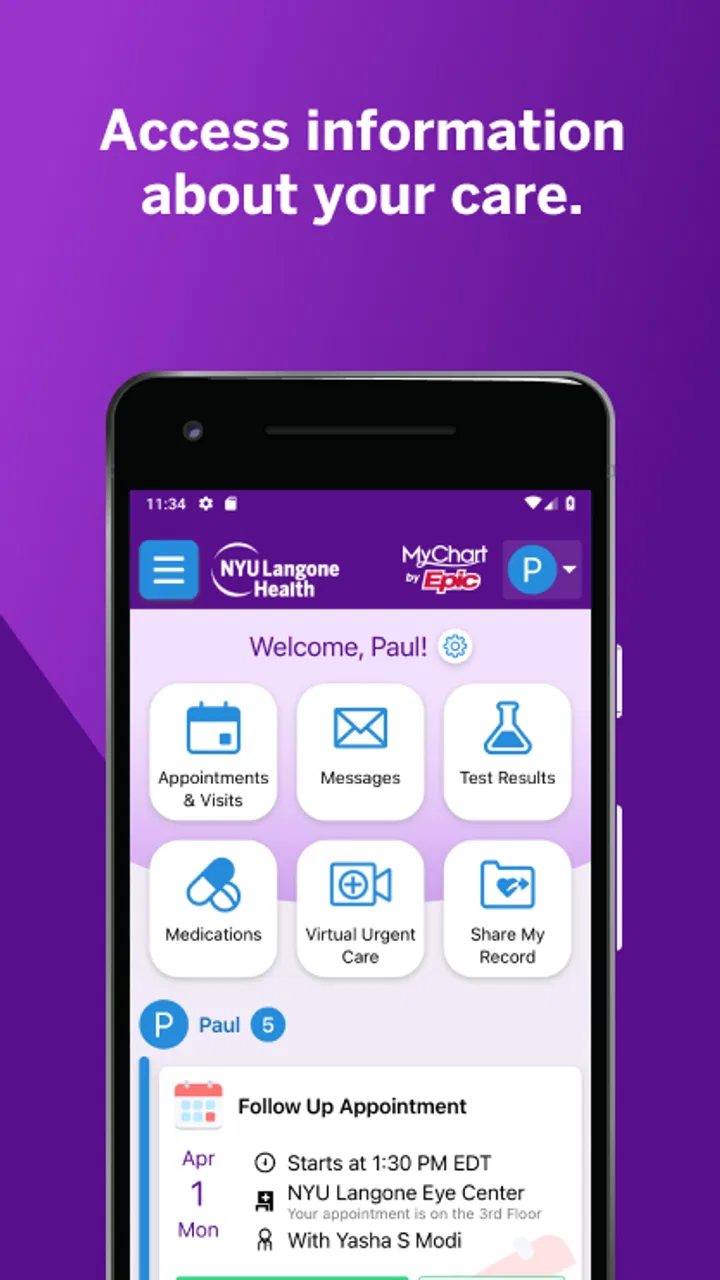
The NYU Langone Health app provides a comprehensive suite of features designed to enhance patient care. Users can schedule appointments, access test results, communicate with healthcare providers, manage prescriptions, and receive personalized health tips. The app also offers virtual urgent care services, making it convenient for patients to receive medical attention from anywhere.
02Is the NYU Langone Health app secure?
Yes, the NYU Langone Health app is designed with stringent security measures to protect users' personal and medical information. It uses encryption and secure login processes to ensure that data remains confidential and accessible only to authorized users. Regular updates and adherence to industry standards further enhance its security.
03How user-friendly is the NYU Langone Health app?
The app is highly user-friendly, featuring an intuitive interface that makes navigation easy for users of all ages. It offers clear instructions and a well-organized layout so that patients can effortlessly access the services they need. Additionally, there are help sections and customer support options for those who may need extra assistance.
04Are there any costs associated with using the NYU Langone Health app?
Downloading and using the NYU Langone Health app is free. However, some services accessed through the app, like virtual urgent care, may incur charges depending on your insurance coverage and the specific services rendered. It's advisable to check with your healthcare provider regarding potential costs.
05Can I use the NYU Langone Health app without being a patient at NYU Langone?
While the app is primarily designed for patients receiving care at NYU Langone Health facilities, some features, like health tips and general information, may be accessible to non-patients. However, full functionality, including appointment scheduling and test results, requires being an NYU Langone patient.
Pros
- User-friendly interface for easy navigation.
- Secure access to medical records anytime.
- Appointment scheduling is quick and simple.
- Offers virtual care options for remote consultations.
- Personalized health tips and reminders included.
Cons
- Limited features for non-NYU patients.
- Occasional login issues reported by users.
- Some features require stable internet.
- Support response can be slow at times.
- Does not integrate with all fitness apps.

NYU Langone Health
Gallery